

As the arrival of Spring draws near and temperatures begin to rise, I've once again observed the resurgence of certain "weeds" that are typically kept in check through mowing. However, at present, the lawn maintenance service has yet to make an appearance. It's worth noting that this property is merely a rental and not my own home; I currently reside here while completing my second year of law school.
Permaculture represents a design system that harmonizes with nature rather than opposing it. Embedded within this approach is a series of principles that emphasize learning through observation and hands-on experience. Over the past decade, I've had the opportunity to dwell in diverse ecosystems and USDA zones, allowing me to conduct experiments with various plant species and environments, ranging from mountainous regions and forests to densely populated urban areas, including condominiums subject to HOA regulations. My journey began in North and Southeast Dallas, and I now find myself in Houston's Third Ward, where I've resided for the past year and a half. Although this region boasts a slightly more tropical climate compared to North Texas, I remain astounded by the nutritional yield derived from what my landlord tirelessly endeavors to maintain as mere grass.
As of February, my yard plays host to several functional weeds:
Carolina Geranium: Recent research suggests the presence of potentially antiviral compounds such as geraniin, ellagic acid, and hyperin in this species. Additionally, it's noted for its capacity to aid in the removal of heavy metals.
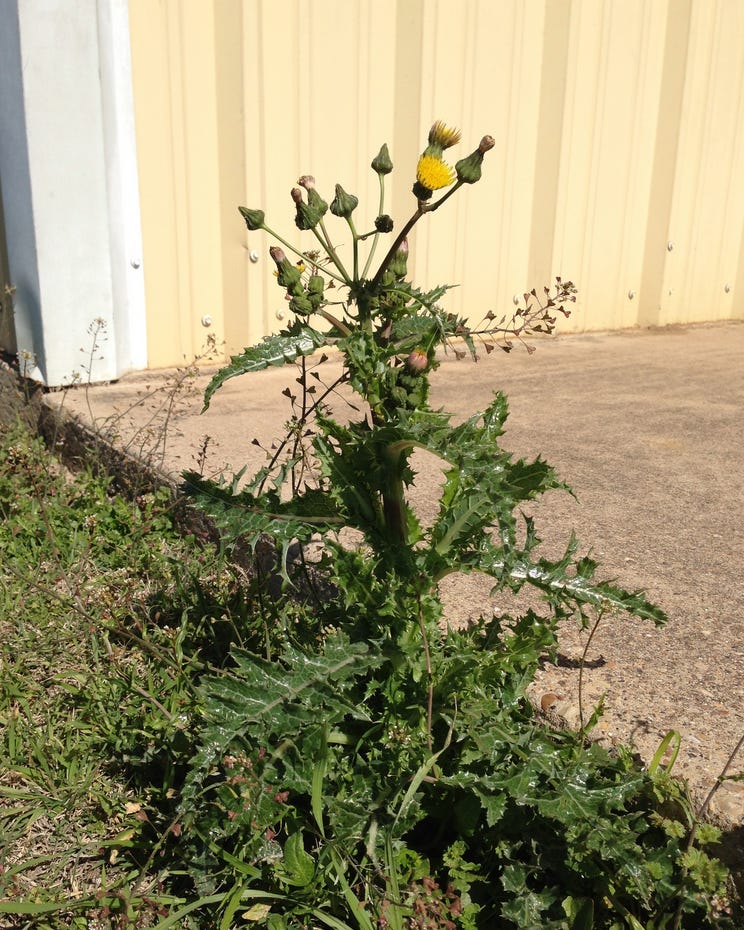
Spiny Sowthistle: Despite its prickly exterior, this plant is edible, bearing a resemblance to the dandelion and emitting a white, milky sap. While tender young leaves are palatable, they toughen with age. Though it’s relative: the dandelion, also makes an appearance (and enjoys favorable public relations), and the prevalence of spiny sowthistle in my yard currently surpasses that of its dandelion counterpart, particularly in mid-February.
Cleavers: This tenacious weed shares a botanical lineage with coffee and offers versatile uses. Its seeds can serve as a coffee substitute, while the shoots can be boiled for consumption or juiced.
Henbit: Cherished by chickens and esteemed by bees and butterflies, this herbaceous plant is not only edible but also attracts beneficial pollinators.
Taro: Revered as one of the earliest crops cultivated by humanity, the tuberous taro plant holds staple status in numerous cultures. Characterized by its expansive leaves and affinity for water, I utilize taro in conjunction with bananas to purify greywater, as detailed in the concept of a Banana Circle.
Bur Clover: This stuff is everywhere in my year. Is is not edible but is a legume that helps lawn fix nitrogen so everything else can grow.
Also see: Purslane, Sorghum, Woodsorrel, Wild Garlic, Goldenrold….
🎁 If you want a traditional garden rather than naturally growing indigenous “weeds” then you can use this planting schedule:
Planting schedules: Texas AgriLife
Here are the basics you need to start your garden. Real farmers make dirt!
🪱 Compost supplies: Uncle Jim worms
Need help retrofitting your property to catch water, build soil, and grow food?
🧑🌾 FREE PERMACULTURE SURVEY FOR YOUR PROPERTY (if you are interested in getting a design from me).
Examples of work: Folio
Testimonials
Books that helped me get here:
🚩 Disclaimer: Make sure you double-check the plants and properly ID and do your research. This is not medical advice.
Follow Baba
Instagram: @golden_age_guide

👏🏼👏🏼👏🏼